

Northstride Joint Care · London
Everyday joint care, one habit at a time
What can you actually do, day to day, to keep knees, hips and hands comfortable as the years add up? Northstride reads the labels, the ingredient names and the movement advice filling this market, then explains what is worth keeping in a normal week.
We don't sell capsules and we don't diagnose anything. Nothing here replaces a conversation with your GP, pharmacist or physiotherapist.
What an ordinary Monday already asks of your joints
Before any product enters the frame, notice the day. Most UK adults spend more hours sitting than any other single posture, then ask their knees to handle stairs, shopping bags and a brisk walk home. That mix is where stiffness and creakiness usually show up first.
The habit side of natural joint care is unglamorous and it is where most of the leverage sits. Break up long sitting with a short stroll roughly every hour. Warm up for two or three minutes before you walk briskly. Keep one strength session in the week, even if it is chair stands and calf raises in the kitchen.
Read the movement sideStairs
A stiff knee on the way down
Coming downstairs loads the knee through more bend than going up, so it is usually the first place people notice a few seconds of hesitation. That delay is information, not a verdict.
Desk
Three hours without standing
Joint fluid responds to movement the way a sponge responds to squeezing. Long stillness leaves a joint feeling drier and more reluctant for the first few steps afterwards.
Grip
Jars, kettles, garden gates
Hand joints get their tolerance from everyday use. Notice which grip tasks you have quietly started avoiding; that list is a better starting point than a product page.
Evening
The hour you actually feel it
Many people feel joints most when they finally sit still. That timing is worth writing down for a fortnight before you change anything, so you can tell later whether a routine did anything.
If your joints sound and feel like this every week, that is a pattern worth tracking rather than a one-off.
What the phrase means
If the muscles around a knee are weak, the joint does more of the work than it should.
What joint wear and tear actually means
"Wear and tear" is the phrase most of us grew up with, though the medical world now prefers "osteoarthritis" or simply age-related joint change. What it describes is gradual: the smooth cartilage lining a joint thins over time, the fluid that cushions movement changes, and the surrounding muscles matter more, not less.
That last part is why this site keeps returning to movement and strength rather than pills alone. It is also why a knee pain solution that starts and ends with a bottle tends to disappoint: the tissues doing the supporting work never got stronger.
Cartilage has no blood supply of its own, so it takes what it needs from the fluid around it. Movement circulates that fluid; stillness does not. Joint comfort tends to change slowly in either direction, which is a reason to judge a routine over seasons rather than days.

Where capsules fit in
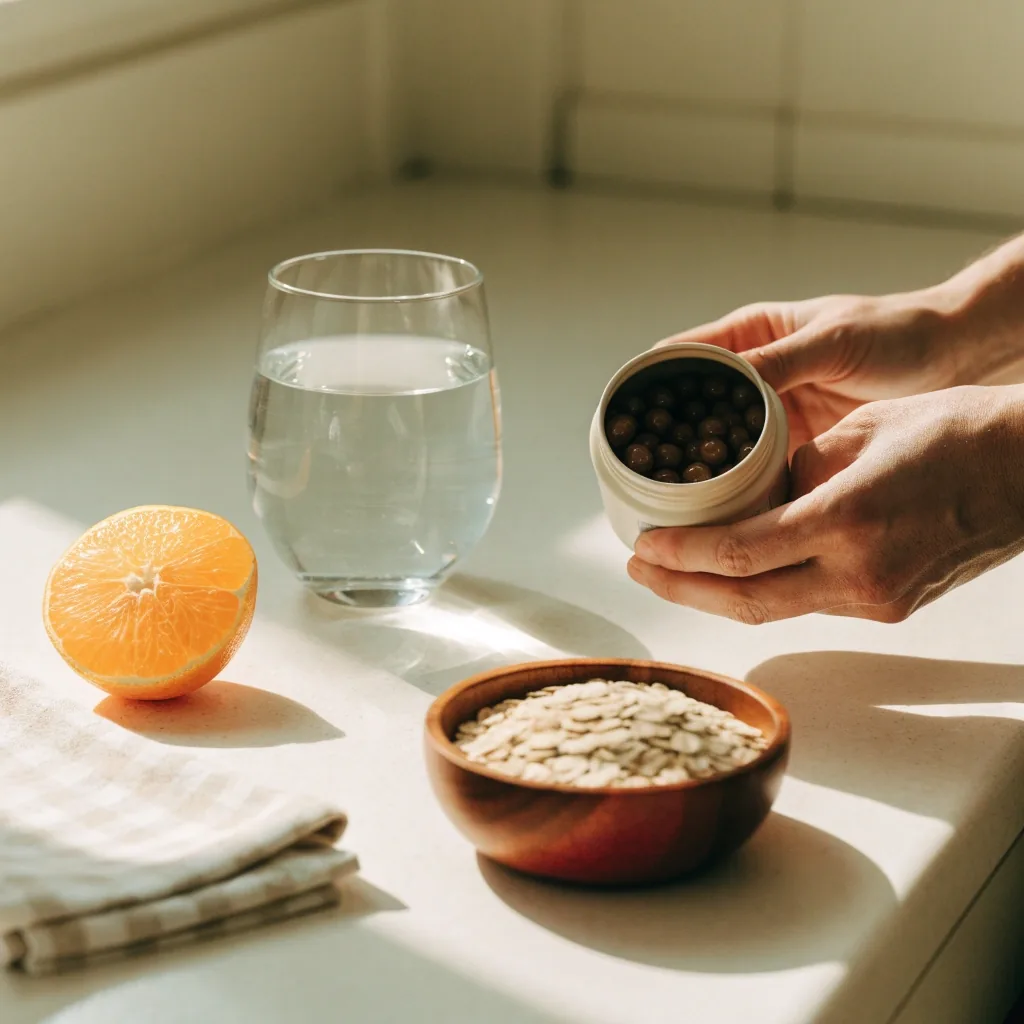
Joint capsules are one of the most common product formats in the UK, and the ingredient lists overlap heavily across brands. You'll see glucosamine and chondroitin, MSM, type II collagen, turmeric or curcumin, boswellia, omega-3, hyaluronic acid, vitamin D and calcium.
None of these is a switch you flip. Think of a capsule as a small daily input that sits alongside sleep, walking, weight and the other things that shape how a joint feels month to month. It is an optional addition, not the foundation.
See how capsules are labelledThe nutrient names you'll keep seeing
-
Glucosamine and chondroitin
The classic pair, and still sold together in many UK ranges. Dose per serving varies enormously between brands, which is why the number on the back matters more than the name on the front.
-
MSM
Turns up in sports nutrition as well as joint formulas, usually framed around connective tissue. It is often one of several ingredients rather than the headline act.
-
Collagen
Particularly hydrolysed collagen, marketed for skin, joints and ligaments at once. Read the gram amount, not just the word collagen on the tub.
-
Turmeric and boswellia
Plant ingredients used in inflammatory-response wording. Note that "response" is doing careful work in that sentence, and it is the honest way to describe what these ingredients are studied for.
-
Vitamin D and calcium
Tied to bone support, which is a different job from cartilage, though the two travel together in marketing. In the UK, vitamin D is a genuine winter consideration for a lot of adults.
Capsules, tablets, powders and drinks
Capsules dominate because they're easy to swallow and easy to dose. Tablets do the same job in a harder format. Powders and drinks let brands load in more ingredients, including protein and vitamin C, without asking you to swallow four pills.
Meritene Mobilis, launched by Nestlé for the UK and Ireland market back in 2018, is a well-known example of a drink positioned across joints, muscles and bones. Format matters less than what you'll genuinely take every day.
Capsules
One or two a day, no taste, no measuring. The format most UK joint ranges are built around, and often the cheapest route to a fixed daily dose.
Tablets
Same ingredients, firmer and usually larger. Worth choosing only if swallowing capsules is genuinely awkward for you and the tablet is easier to manage.
Powders
Room for bigger amounts of collagen and protein per serving. The trade-off is a scoop, a shaker and a texture you have to want to drink daily.
Drinks
Ready-made formats positioned across joints, muscles and bones. Convenient, and usually the most expensive way to deliver the same handful of nutrients.
Judge it over seasons
Joint comfort tends to move slowly in either direction. That is a reason to judge a routine over seasons, not days.
Search terms like "restore joints quickly" or "relieve pain fast" are everywhere in this niche, and they set an expectation the body rarely meets. This site avoids cure language entirely, because no supplement is licensed to treat arthritis.

Reading a label without a chemistry degree
Start with the ingredient list and the amount per serving, not the marketing name. A "joint complex" means little until you know whether it's 500 mg of glucosamine or 50 mg. Look for a UK manufacturer statement if origin matters to you; Nutravita highlights domestic manufacture, and check whether the formula is one ingredient or a stack.
Two products can share a shelf and share almost nothing else. Same front-of-pack words, wildly different amounts, different formats, different price per day. Price per day is the number worth comparing, not the price on the tub.
Capsules for healthy legs, capsules for body pain, natural leg capsules: the pack copy changes, the ingredients often do not. Read the panel and the marketing fades into background noise.
Building a joint-friendly day
A day is easier to rebuild than a lifestyle. Here is the order that does the most for joint comfort per unit of effort, from the things that matter most downward.
-
01
Warm up first
Two or three minutes of easy movement before a brisk walk. Cold starts are what make joints feel older than they are.
-
02
Break up sitting
A short stroll roughly every hour beats one long walk at the end of the day, especially on desk-heavy weekdays.
-
03
Keep some strength work
Even chair stands and calf raises at home count. Strong muscles take load off the joint itself, which is the point.
-
04
Stretch what you'll repeat
One stretch you actually do beats five you skip. Choose the hips, calves or shoulders that pinch first in your own day.
-
05
Eat for bone and muscle
Enough protein, vitamin D in winter, calcium from food where possible. These support the structures that carry the joint.
Ingredients versus habits
A capsule is a small, consistent input. A habit is a larger, slower one. The evidence-minded way to think about it is that your daily movement, body weight and sleep do most of the work, and a supplement formula is an optional extra many adults choose to include.
That order of priority is the single most useful thing this site can tell you. It also explains why the same formula can feel like it helped one person and did nothing for another: the habits around it are doing most of the moving. If you want a knee pain solution or joint pain relief, the routine and the joint pain aid you choose need to be judged together, over the same stretch of time.
For most people, that means: pick a movement routine you can hold, then decide whether you want to add anything on top. Support joints daily with habits first, then capsules if you want them.
Compare joint support formatsWhere the weight actually sits
Daily movement and strength
Most of it
Body weight and sleep
A large share
Diet and bone nutrients
Supporting role
A capsule formula
Optional input
A relative picture of where the day-to-day influence sits, not a measured result from any one product.
Who this is written for
Our reader is usually a UK adult in their forties, fifties or sixties who wants to stay active, not an athlete chasing performance. Some are managing a stiff knee on stairs. Others just want to walk the dog without thinking about it.
The advice leans toward gentle, sustainable routines because those are the ones people keep. Restore joint strength and restore joint mobility are worthwhile goals, and both come from a modest amount of work done consistently rather than a hard burst you abandon in March.
Reader
Adults who want their usual walks, stairs and gardening to stay unremarkable. You are not training for a marathon and you don't want a lecture about it.
Starting point
One stiff knee, a cautious hip, hands that ache after a cold morning. Small, specific complaints rather than a single dramatic event.
Goal
Fast pain relief is not a realistic promise, and fast joint recovery is not what this site offers. Steady, ordinary maintenance is.
Not for
Anyone looking for a diagnosis, a treatment plan, or a supplement that promises to eliminate joint pain. That is a conversation for your GP or physiotherapist.
How to use this site
Four routes cover almost everything a reader asks. Start wherever you actually are today, not where you think you should be.
Daily Joint Care
A routine to copy if you want something to actually follow this week, built around movement, strength and pacing.
Nutrients & Capsules
For standing in a shop squinting at a label, deciding whether a formula is worth the money per day.
Movement & Mobility
The physical side in plain terms: what to warm up, what to strengthen and how to keep going on a low-motivation week.
Comparing Joint Support Options
A neutral framework for when two products look identical and the packaging tells you nothing useful.
Nothing here replaces a conversation with your GP, pharmacist or physiotherapist. If joint pain is persistent, if a joint swells, or if it locks, that is a doctor's appointment rather than a supplement question.

A word on expectations
What this site will and will not tell you
We won't tell you a capsule will transform your knees, and we won't quote a study you can't check. What we can do is explain the ingredients UK brands actually use, describe the habits that realistically help, and point you toward a doctor when something needs a diagnosis rather than a supplement. Natural joint care is slow work, and slow work is still work.
Editorial office: 48 Harley Street, Marylebone, London W1G 9PP · Monday to Friday, 9:00 AM – 6:00 PM; Saturday, 10:00 AM – 2:00 PM.
Questions readers send us most
These four come up again and again, usually in this order. If your question is not here, the editorial team answers the ones we can.
Is a joint capsule a treatment for arthritis?
No. Supplements are food products, not medicines, and nothing on this page diagnoses or treats a condition. If you have persistent joint pain, swelling or a joint that locks, see your GP.
How long before a routine makes a difference?
Joint comfort changes slowly, so people typically judge habits like walking or strength work over weeks and months, not days. Be sceptical of any product promising otherwise.
Do I need capsules at all?
Plenty of adults support their joints through movement, weight management and diet alone. Capsules are an optional addition, which is why we cover them alongside habits rather than instead of them.
Which format is easiest to keep up?
Whatever you'll take without thinking, consistently. For many people that's one capsule a day; for others a powder or drink fits better. Consistency matters more than format.
Read our full terms of service and privacy policy for how this site is run.